
Southern Gothic Glamour: Dramatic, Architectural Eyewear for New Orleans Film & Arts Professionals
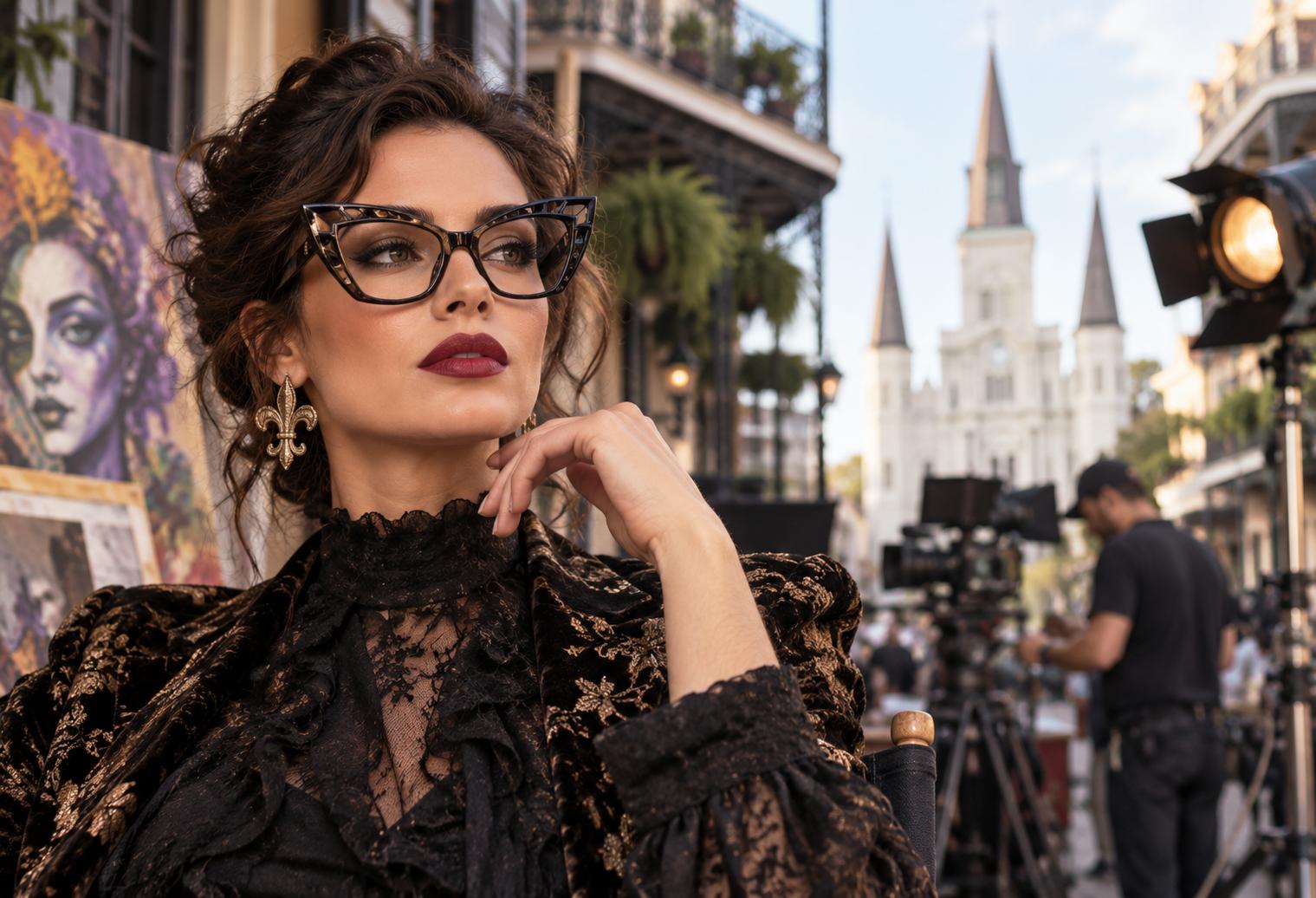
New Orleans has never been a city that asks creative people to disappear into the background. From a production meeting in the Central Business District to a gallery opening on Julia Street or a late set call near the French Quarter, personal style often becomes part of the visual language of the room.
For filmmakers, designers, photographers, performers, architects, curators, and other arts professionals, eyewear can do more than correct vision. The right frames can function almost like architecture for the face.
Quick answer: Dramatic, architectural eyewear works especially well for New Orleans creative professionals because it combines visual impact with personal identity. Sculptural silhouettes, strong acetate, unusual geometry, expressive color, and distinctive metalwork can turn glasses into a deliberate part of a professional wardrobe without requiring an overly formal or trend-driven look.
What local creatives should know
-
Architectural eyewear relies on shape, proportion, material, and construction rather than a prominent designer logo to create visual impact.
-
The eclectic visual culture of the Marigny, Bywater, French Quarter, and Arts/Warehouse District makes expressive eyewear feel at home rather than out of place.
-
Frames that photograph beautifully are not automatically comfortable for a full production day, so fit and lens needs should remain part of the decision.
-
Color can be dramatic without being loud. Deep tortoise, translucent smoke, oxblood, saturated jewel tones, and unusual metals can provide presence with versatility.
-
Your glasses sit directly within your line of communication, making them especially noticeable during client meetings, screenings, auditions, gallery events, and creative presentations.
Why Does Architectural Eyewear Work So Well in New Orleans?
Architectural eyewear works particularly well in New Orleans because the city already celebrates contrast, ornament, history, reinvention, and strong individual expression. A sculptural frame can feel as natural beside wrought iron, Creole cottages, industrial lofts, and colorful façades as a restrained pair might feel in a more conservative visual environment.
Consider the range of settings local professionals move through. The Garden District offers elaborate historic forms and lush streetscapes. The French Quarter combines intricate ironwork with layered architectural history. Bywater and the Marigny mix colorful homes, studios, music venues, and contemporary creative spaces. The Arts/Warehouse District pairs older industrial structures with galleries and modern interiors.
Eyewear with strong geometry, unusual curves, layered acetate, or unexpected construction reflects that same tension between heritage and experimentation.
The goal is not to dress like the city. It is to choose frames with enough personality to belong in a place where visual identity matters.
What Makes Eyewear Feel Dramatic Without Looking Like a Costume?
Dramatic eyewear feels sophisticated rather than theatrical when the frame has a clear design idea and still works with your face, wardrobe, and daily routine. The most successful statement glasses usually have one or two dominant characteristics instead of competing for attention in every possible way.
A thick geometric acetate frame can make its statement through silhouette alone. A finer metal frame might rely on unusual angles, asymmetry, or an unexpected bridge. Another design may use translucent color or layered material while keeping the shape relatively restrained.
For New Orleans film and arts professionals, consider how the frame works across several environments.
You may wear the same glasses during an early production meeting, hours behind a monitor, an Uptown lunch, and an evening opening downtown. A successful dramatic frame should still feel intentional after the novelty wears off.
Think less about finding the strangest pair in the room and more about finding the pair that looks unmistakably like yours.
Which Frame Shapes Create the Strongest Architectural Look?
Architectural frame shapes create impact through proportion, angles, negative space, and controlled exaggeration. Oversized squares, strong rectangles, angular cat-eyes, sculpted rounds, unconventional polygons, and frames with pronounced brow lines can all create structure around the eyes.
Face shape does not have to dictate your choice through rigid rules. Contrast is often more interesting.
A rounder face can gain definition from crisp angles, but a bold round frame may create an equally compelling graphic effect. A narrow face might work beautifully with an elongated geometric shape, while someone with strong features may choose either equally strong eyewear or a surprisingly delicate metal construction.
Try looking at the relationship between the frame and your entire face rather than categorizing yourself according to one facial shape.
Pay attention to where the top line sits near your eyebrows, how the lower edge interacts with your cheeks, and how far the frame extends toward your temples.
Those relationships often determine whether dramatic glasses look architectural or simply oversized.
How Should Film and Arts Professionals Choose Frames for Long Workdays?
Film and arts professionals should choose expressive frames that remain comfortable through the actual hours and visual tasks their work demands. A frame may look extraordinary during a five-minute fitting, but its weight, bridge fit, temple pressure, and lens requirements become much more noticeable during a long production or studio day.
Art & Eyes approaches eyewear as aesthetic expression, with a collection centered on distinctive design and craftsmanship rather than simply following logos and mass trends.
For our clients, that means the visual conversation should happen alongside practical questions.
Do you spend hours looking between a monitor and people across a room? Are you working under studio lighting? Do you frequently move between indoor and outdoor locations? Do you edit, illustrate, design, or perform other close visual work for extended periods?
Those habits matter when considering both frames and lenses.
The most dramatic pair is not necessarily the largest or heaviest. Some highly sculptural designs achieve their effect through intelligent geometry, thin metalwork, negative space, or lightweight construction.
How Can Color Create Southern Gothic Glamour?
Southern Gothic glamour comes from combining richness, mystery, romance, and a slightly unconventional edge rather than relying only on black frames. Deep colors and unusual translucent materials can create far more dimensional results while remaining easy to integrate into a creative professional wardrobe.
Black certainly works, especially in a strong silhouette. But consider tobacco tortoise, smoky crystal, moss, wine, aubergine, midnight blue, bronze, antique gold, or deep red.
Translucent acetate can be particularly effective in Louisiana light because it changes character depending on the setting. A frame may appear dark and restrained indoors, then reveal layers of color outside.
For professionals who wear a lot of black, white, denim, or neutral clothing, eyewear can become the controlled source of color.
Someone with a highly patterned or colorful wardrobe may prefer the reverse: an unusually shaped frame in a quieter material.
What Are the Signs That Your Current Eyewear No Longer Fits Your Creative Identity?
Your current eyewear may no longer fit your creative identity when you continually treat your glasses as something to work around rather than something that contributes to your appearance. Because glasses occupy the center of the face, even technically functional frames can feel wrong when their scale, color, shape, or personality no longer reflects you.
Common signs include:
-
You regularly remove your glasses for photographs even though you normally wear them.
-
Your frames feel visually anonymous compared with the rest of your wardrobe.
-
They slide, pinch, hit your cheeks, or become irritating during long work sessions.
-
You love your clothing and accessories but feel your eyewear belongs to an earlier version of your style.
-
Your frames disappear completely when what you really want is definition.
-
You chose your current pair mainly because it seemed safe.
-
You keep admiring stronger frames on other creative professionals but assume you cannot wear them.
The last point is especially worth challenging. Many dramatic frames look far more wearable on a face than they do sitting alone on a display.
What Common Mistakes Should New Orleans Creatives Avoid When Choosing Statement Glasses?
The most common statement-eyewear mistakes happen when visual excitement overrides proportion, comfort, or personal relevance. New Orleans gives creative professionals plenty of permission to dress expressively, but a distinctive frame still needs to work as an object you may wear for thousands of hours.
Mistake: Choosing drama only through size.
Consequence: The frame can overwhelm your features or become unnecessarily heavy.
Better approach: Explore unusual angles, color, construction, or material as alternative ways to create impact.
Mistake: Buying for one outfit or event.
Consequence: Extraordinary glasses stay in a case instead of becoming part of your identity.
Better approach: Test the frame mentally against your normal work wardrobe.
Mistake: Ignoring the side view.
Consequence: A frame that looks interesting head-on may feel ordinary from other angles.
Better approach: Examine temples, hinges, thickness, and profile.
Mistake: Treating comfort as secondary.
Consequence: You stop wearing the pair during precisely the long days when you need it.
Better approach: Consider bridge contact, temple fit, frame weight, and lens needs along with aesthetics.
What Is a Common New Orleans Creative-Professional Eyewear Scenario?
A common New Orleans scenario is a creative professional who needs one pair of glasses to move convincingly between practical work and highly visual social environments. The challenge is finding eyewear with enough personality for an opening or screening without feeling distracting during an ordinary working day.
Imagine a creative director starting with a meeting near Magazine Street, heading downtown for a site visit, spending the afternoon reviewing work on a screen, and ending the evening at an Arts/Warehouse District event.
A generic frame may function everywhere but contribute nothing.
An excessively theatrical frame may feel exciting at night but tiring at noon.
The stronger option is often a piece with disciplined drama: excellent proportions, an unusual silhouette, rich material, or one memorable construction detail.
That is where architectural eyewear becomes useful. It provides identity without requiring a costume change.
How Should You Compare Understated and Statement Eyewear?
Understated and statement eyewear should be compared according to how much visual presence you want your glasses to have, not according to which category is more sophisticated. Both can be excellent choices, but they communicate very differently in visually driven professional environments.
Understated frames tend to support the rest of your appearance quietly. Statement frames participate actively in it.
For someone who directs, designs, performs, photographs, curates, or regularly presents creative work, that participation can be useful. Distinctive glasses can become a recognizable part of your professional presence.
You also do not have to choose one identity permanently.
A restrained everyday pair and a more architectural second pair can create different visual registers for production work, meetings, performances, openings, and events.
Where Can New Orleans Professionals Explore More Expressive Eyewear?
New Orleans professionals can explore expressive eyewear by looking beyond familiar mass-market silhouettes and trying frames in person with attention to shape, construction, color, and fit. For anyone accustomed to choosing the safest available pair, physically trying unfamiliar proportions can significantly change what feels possible.
Our focus is on eyewear for people who see glasses as part of their visual identity, including bold shapes, bright acetates, elegant angles, unusual designer work, and evolving frame selections.
For creative professionals coming from Uptown, the Garden District, the CBD, the French Quarter, Marigny, Bywater, or surrounding communities, the objective is the same: find eyewear that feels distinctive on your actual face rather than interesting only in theory.
What Does Waiting to Replace the Wrong Frames Cost You?
Waiting to replace eyewear that no longer works can mean continuing with avoidable discomfort, visual frustration, or a style that feels disconnected from your professional identity. The issue is less about chasing fashion and more about recognizing that glasses are an everyday object with both functional and visual consequences.
For people who wear prescription eyewear throughout the day, frames are not an accessory that appears occasionally.
They are present in meetings, photographs, screenings, rehearsals, studio sessions, client conversations, and ordinary moments around the city.
If you already know your current pair feels uncomfortable or visually wrong, treating the next pair more deliberately can make sense.
FAQ About Dramatic Eyewear in New Orleans
Dramatic eyewear in New Orleans can be practical, professional, and highly wearable when shape, fit, materials, lenses, and personal style are considered together. These are some of the most common questions creative professionals may have before moving toward a stronger frame.
Are bold glasses professional enough for New Orleans film industry work?
Yes. Bold glasses can look highly professional when their proportions and design feel intentional. In creative industries, distinctive eyewear can complement a strong visual identity without interfering with professionalism. For long production days, however, comfort, stability, lens requirements, and the practical demands of your role should remain part of the decision.
What eyewear styles fit the New Orleans arts scene?
Sculptural acetate, expressive color, unusual metalwork, strong geometric forms, and distinctive vintage-influenced shapes can all feel natural within the New Orleans arts scene. The city does not demand a single aesthetic. A Julia Street gallery professional may choose something completely different from a Bywater artist or Frenchmen Street performer.
Do statement glasses have to be oversized?
No. Statement glasses do not have to be oversized because visual impact can come from geometry, color, unusual bridges, material combinations, temple design, or negative space. A relatively compact frame with an unexpected construction can attract more attention than a very large conventional shape.
Are dark frames the best choice for Southern Gothic style?
No. Dark frames are only one route to a Southern Gothic look. Deep tortoise, burgundy, moss, smoke, bronze, translucent neutrals, and jewel-toned acetates can create a rich, atmospheric effect without defaulting to solid black. The best color should also complement your coloring and everyday wardrobe.
What should New Orleans professionals consider when moving between indoor and outdoor locations?
New Orleans professionals who frequently move between interiors and outdoor locations should consider how their eyewear performs across changing light, heat, and work environments. Frame comfort, prescription needs, sun protection, and appropriate lens options may all matter depending on the wearer. Function should be discussed alongside frame aesthetics rather than treated as an afterthought.
Can architectural eyewear work with a minimalist wardrobe?
Yes. Architectural eyewear often works especially well with minimalist clothing because the glasses can provide the primary shape or visual detail. A wardrobe built around black, white, denim, or neutral pieces can support a strong acetate color, sculptural metal frame, or exaggerated silhouette without making the overall look feel crowded.
Should I choose eyewear based on my face shape?
Face shape can provide a starting point, but it should not become a rigid rule. Proportion, eyebrow placement, bridge fit, cheek clearance, coloring, personality, prescription, and the effect you want all matter. Trying unexpected shapes in person is often more useful than eliminating them because of a generic face-shape category.
Where can creative professionals from the Garden District or Uptown explore distinctive eyewear?
Creative professionals in the Garden District, Uptown, and surrounding New Orleans neighborhoods can visit us on Magazine Street to explore eyewear with an emphasis on individual design and visual expression. Bringing examples of your normal wardrobe or simply explaining how you want your next glasses to feel can help focus the selection process.
Give Your Point of View a Stronger Frame
New Orleans rewards people with a point of view. Your eyewear can reflect that same confidence while still meeting the practical needs of long working days, changing environments, and a creative professional life.
Find Eyewear That Looks Like It Belongs to You
Categorised in: Eyewear